-
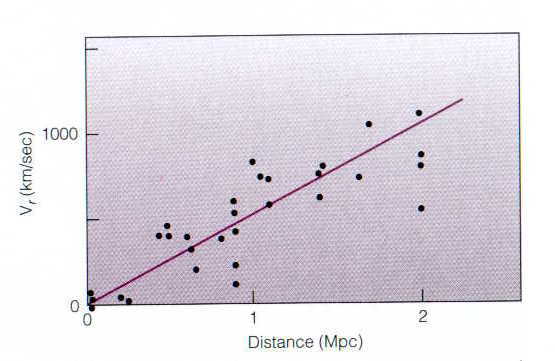
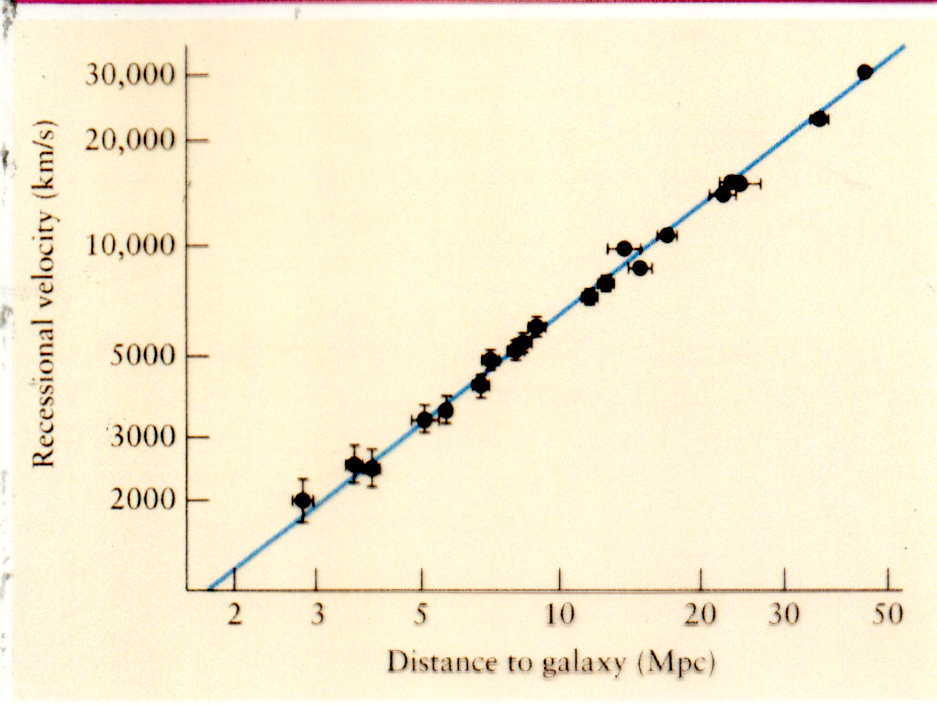
In 1929, Edwin Hubble published his discovery of the relation
between red shifts and distances of galaxies within 2 Mpc, later in 1931 extended
to 32 Mpc
-
The red shift is "interpreted" as a receding velocity (can
it be something else?)
z = (l1-l)0/l 0= (1+br)/(1-b2)1/2 - 1
b = [(z+1)2-1]/[(z+1)2+1] for b=br
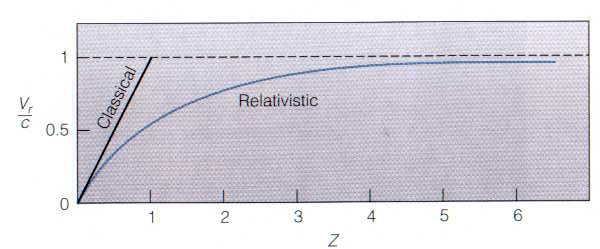 [b(z)]
b ~ z for b=br << 1
-
The Hubble law
v(=cz) = Hd (only valid for z << 1; for larger z, the relation between z (the redshift) and d (the distance) is an important issue)
Its value ranges from 50 km/sec/Mpc ~ 100 km/sec/Mpc.
A recently often quoted value is 70 km/sec/Mpc.
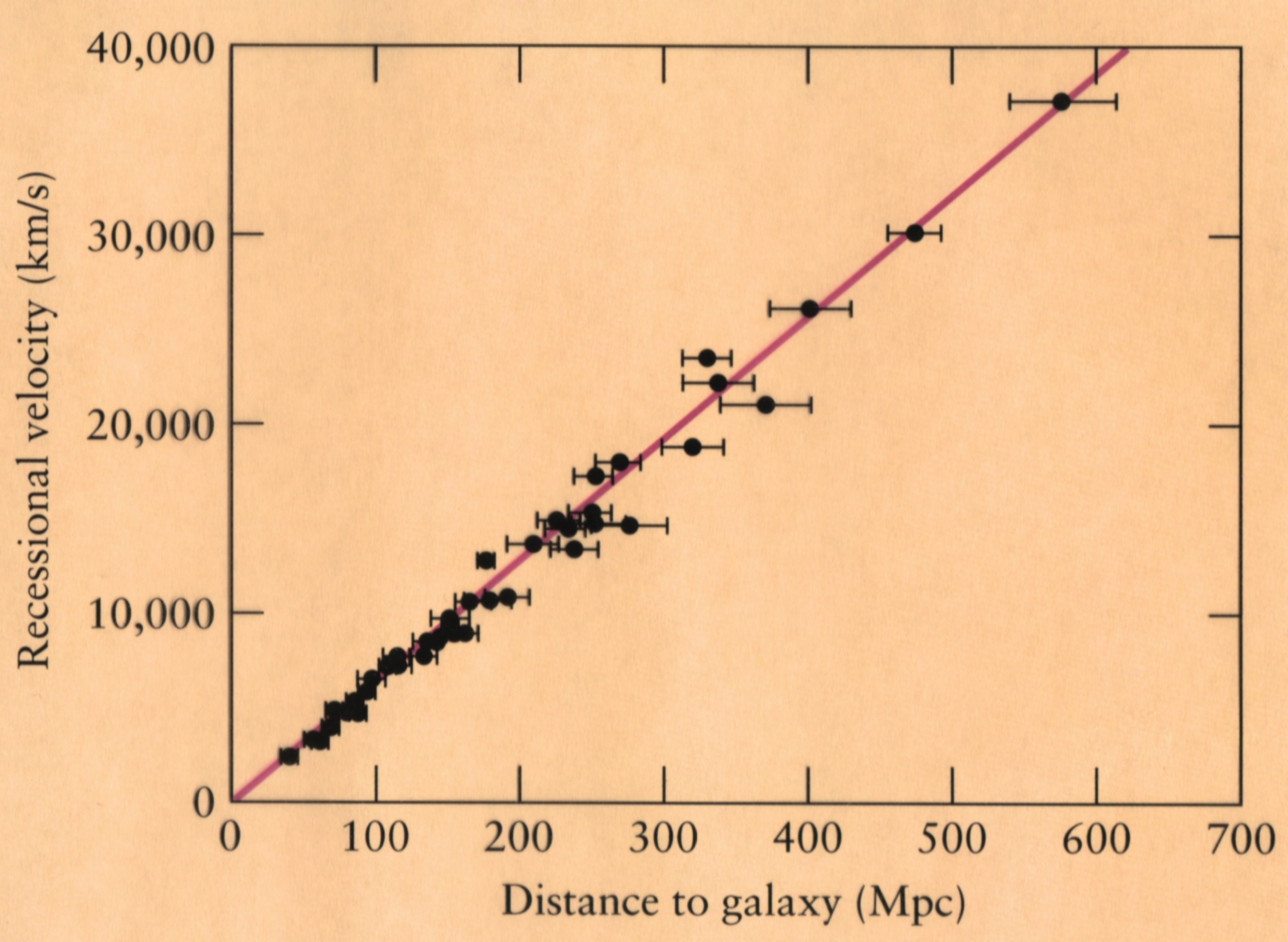
(check Hubble's original value ~560 km/sec/Mpc)
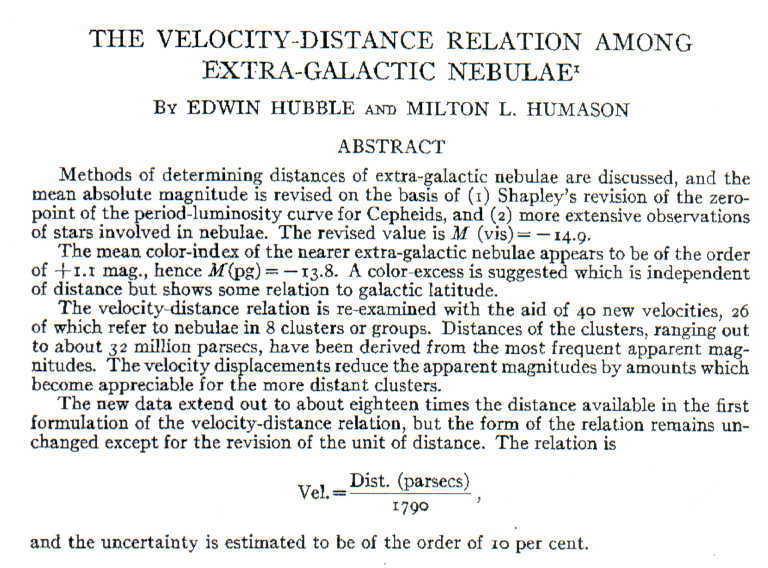 [Hubble 1931 paper]
The distance is very often expressed like d = 90 Mpc h-1, where h=H/100 km/sec/Mpc
Galaxies have their own local, intrinsic motion.
M31 is actually approaching us, blue-shifted.
At larger distance, the 'Hubble flow velocity' dominates
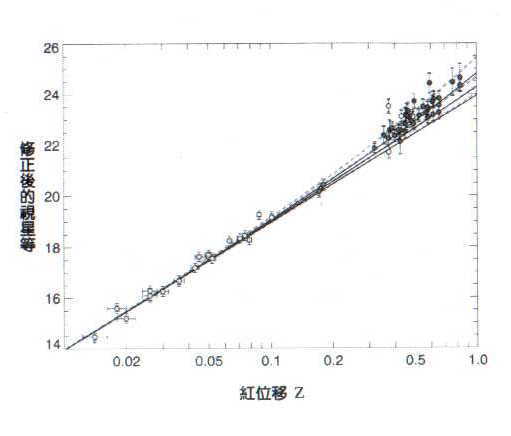 [the SN Type-Ia d-Z diagram; the "calibrated apparent magnitude" in
the ordinate (y-axis) corresponds to the (luminosity) distance. ]
[the SN Type-Ia d-Z diagram; the "calibrated apparent magnitude" in
the ordinate (y-axis) corresponds to the (luminosity) distance. ]