average density as a rough guide; samples available only from Venus, Moon, and Mars so far
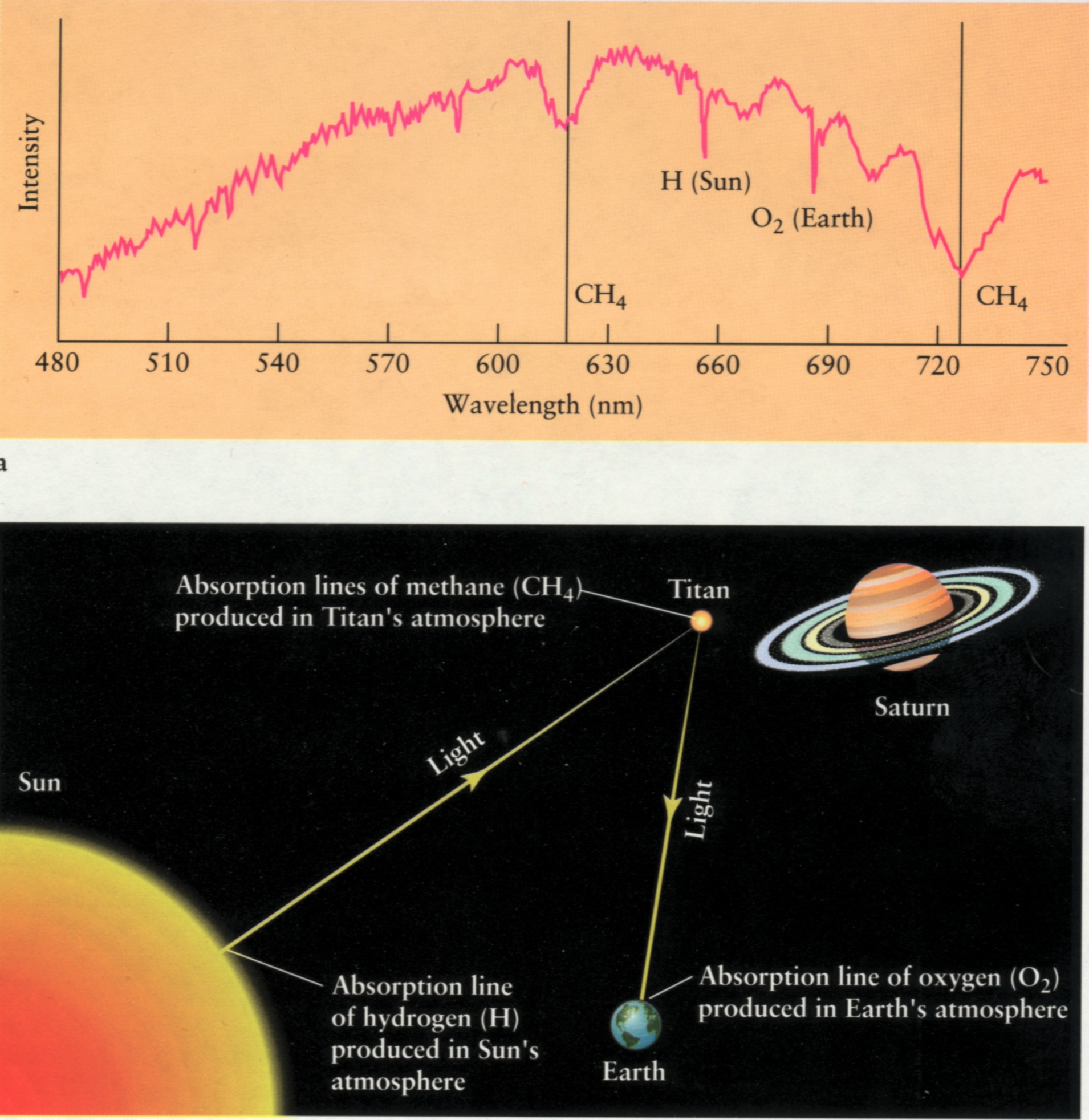 [Composition of Titan's atmosphere can be probed from its spectrum.
Not shown in this part of spectrum is N2 found in UV and
compounds of C and H found in IR. For in situ measurement at Titan, check
ESA Cassini-Huygens mission.]
[Composition of Titan's atmosphere can be probed from its spectrum.
Not shown in this part of spectrum is N2 found in UV and
compounds of C and H found in IR. For in situ measurement at Titan, check
ESA Cassini-Huygens mission.]
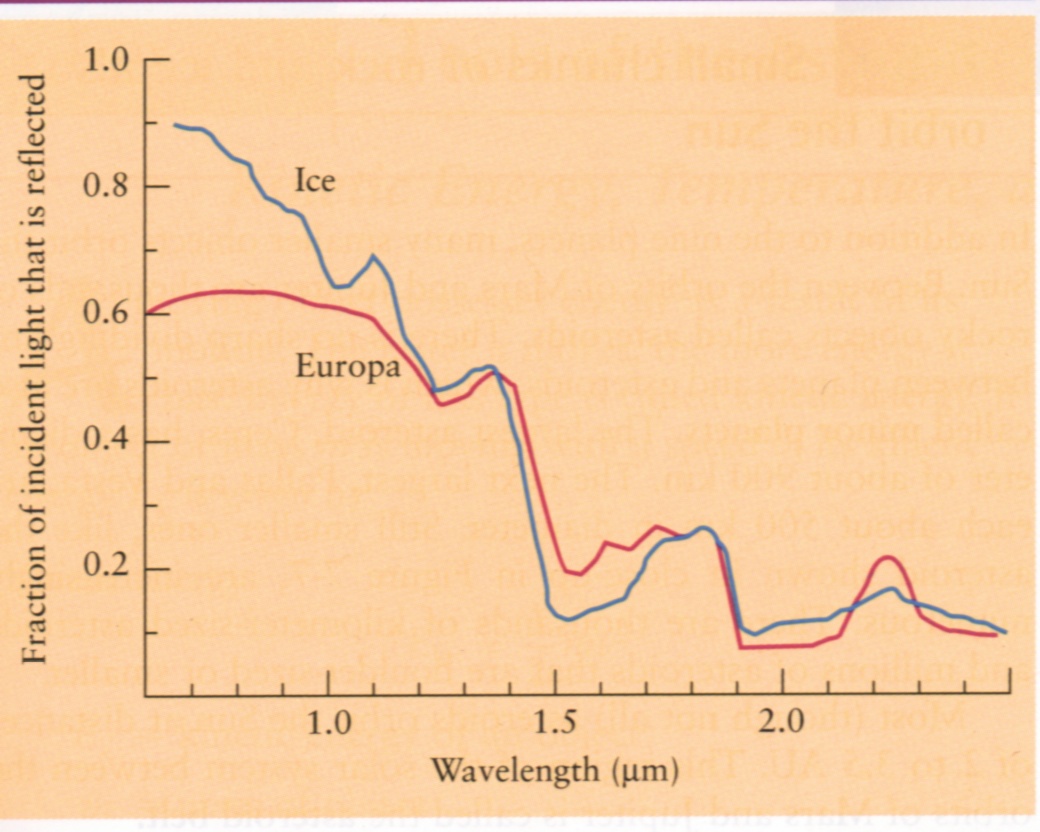 [Europa's solid surface (frozen water!) inferred from its reflection spectrum.
Check ESA JUICE for a future mision to
Jupiter and its satellite Europa.]
[Europa's solid surface (frozen water!) inferred from its reflection spectrum.
Check ESA JUICE for a future mision to
Jupiter and its satellite Europa.]
escape velocity Ves=(2GM/R)1/2
gas thermal velocity Vth=(3kT/m)1/2
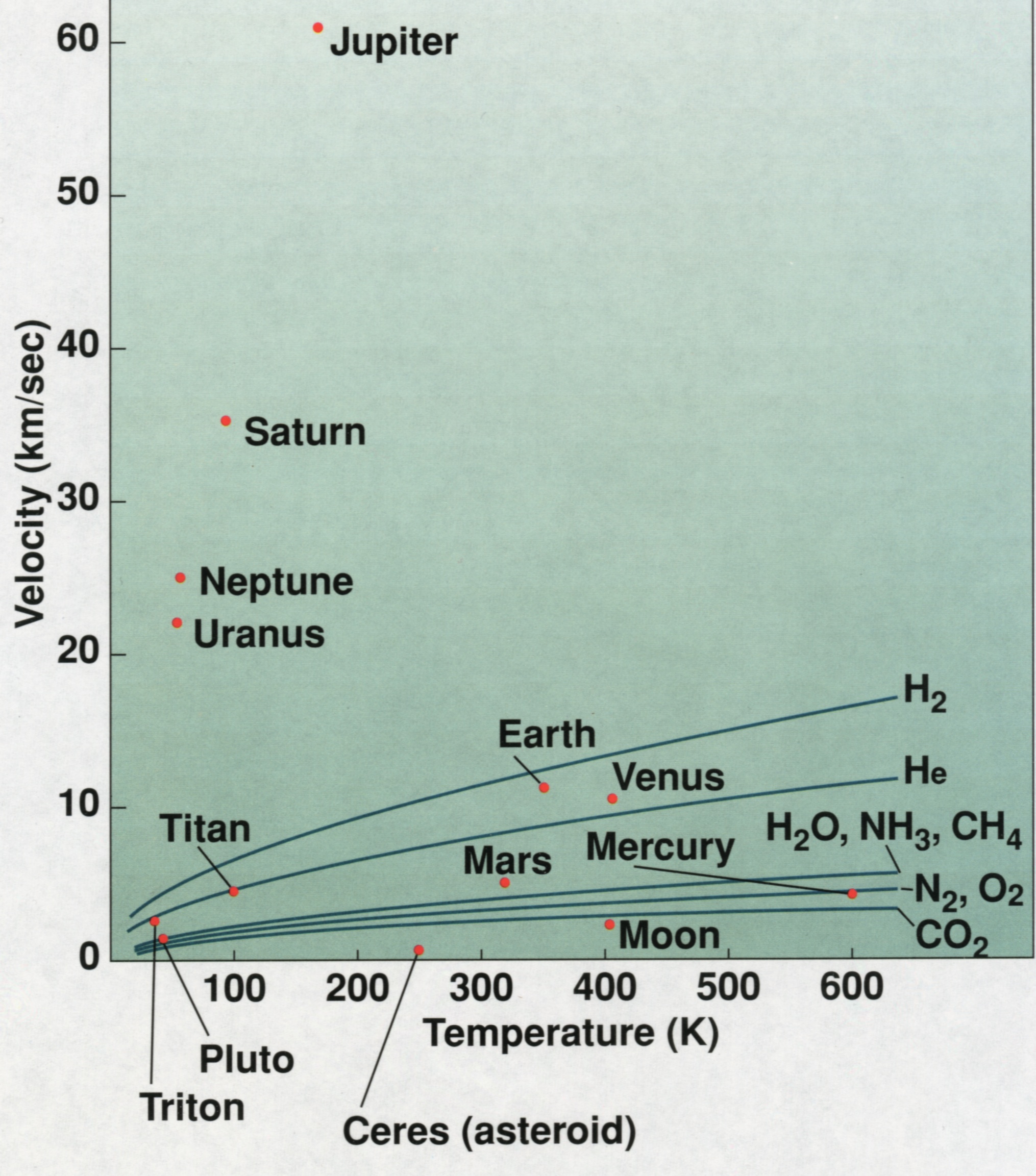 [In this figure, solar system bodies are plotted with red dots based on their
surface temperature and escape velocity. Curves for different gases are their
thermal velocity (times 6) as a function of temperature.]
[In this figure, solar system bodies are plotted with red dots based on their
surface temperature and escape velocity. Curves for different gases are their
thermal velocity (times 6) as a function of temperature.]
The solar-system abundances, whose major source is the Sun, are similar to the overall cosmic abundances determined from spectra of stars in the Galaxy: H is about 3/4 and He is about 1/4 in mass, with various amounts of heavier elements.
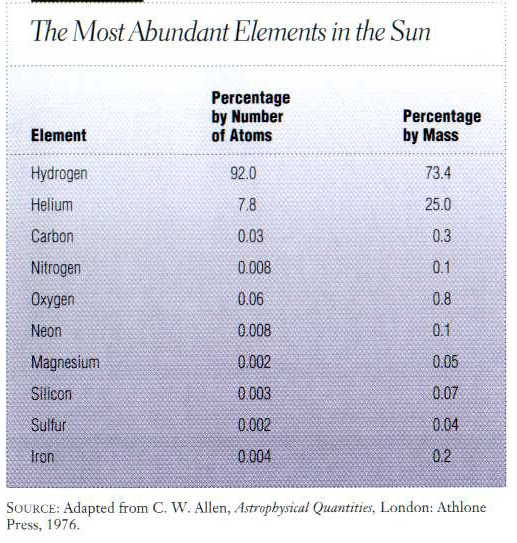 [The top 10 abundant elements in the solar photosphere. H and He make up 98% in mass.]
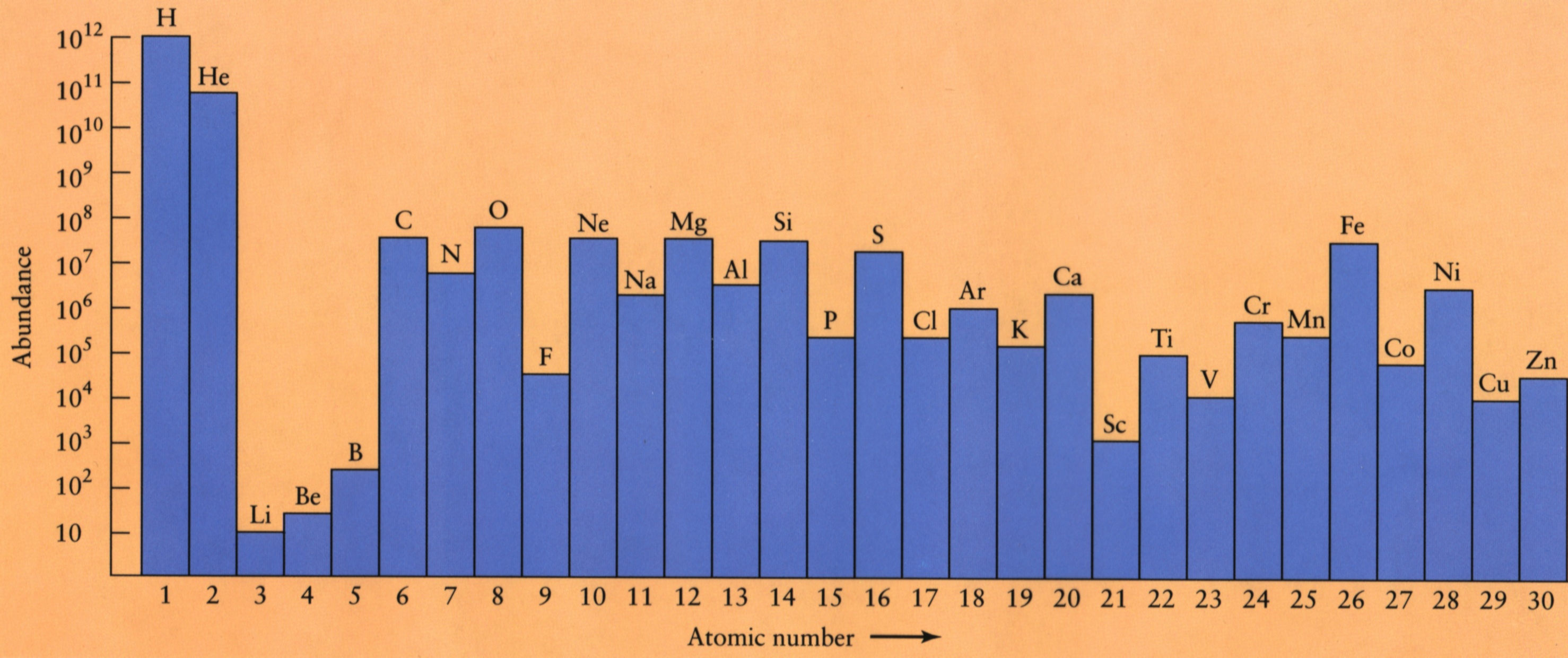 [The cosmic abundances of lighter elements compared with 1012 H atom.
Those of elements heavier than zinc are less than 1000 atoms per
1012 H atom.]
[The cosmic abundances of lighter elements compared with 1012 H atom.
Those of elements heavier than zinc are less than 1000 atoms per
1012 H atom.]
In the early universe, only H and He, plus very little Li and Be, were produced.
Other elements are all produced in stars; check General Astronomy (I).
We are all made of "star dust", or "re-cycled stellar material".